

On this page
9 sectionsBrowse the main headings and deeper subtopics from this article.
Recommended next
Next.js Landing Page Generator: The 2026 Standard for Real, Editable, Production-Ready Landing Pages

If you’re a founder, freelancer, or small agency launching a product in 2026 — and you’ve searched for a Next.js landing page generator — you’ve likely hit the same wall: tools that promise AI speed but deliver static HTML, non-responsive mockups, or locked-in no-code dashboards. What’s missing isn’t more AI — it’s production-grade output. A true Next.js landing page generator in 2026 must produce real, type-safe React components, server-side rendering (SSR) or static site generation (SSG) support, responsive Tailwind styling, and full editability — not just a screenshot or a ZIP of broken assets.
ZyloCode is the only AI website builder built specifically to meet that standard. It generates complete, production-ready Next.js 14+ apps — not templates, not previews, not abstractions — from plain English prompts. You get live-preview, real-time editing in a built-in VS Code–style editor, seamless deployment to Vercel or Netlify, and full code export. No handoffs. No developer dependency. Just your idea → your site → your domain — in minutes.
What Defines a True Next.js Landing Page Generator in 2026?
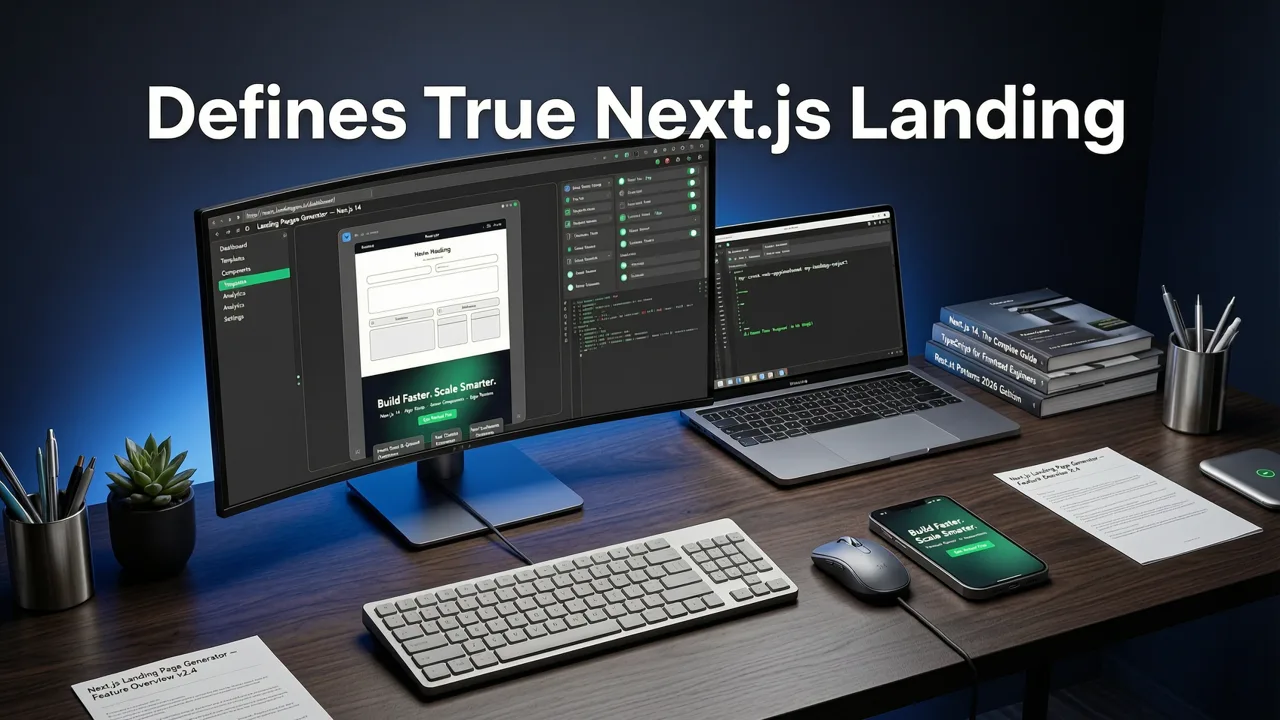
A Next.js landing page generator isn’t just another AI prompt-to-HTML tool. In 2026, the bar has risen — and rightly so. With Next.js 14’s App Router now mature, Turbopack stable, and React Server Components (RSC) widely adopted, users expect more than visual fidelity. They demand technical fidelity.
Here’s what separates a genuine Next.js landing page generator from legacy alternatives:
- Real Next.js project structure: Not a single HTML file — but
app/,components/,lib/,public/,next.config.js, and TypeScript type definitions — all generated and organized per official Next.js conventions. - Tailwind CSS integration out-of-the-box: Responsive, utility-first classes applied semantically — no inline styles, no hardcoded pixels, no media query duplication. Every breakpoint (
sm,md,lg,xl,2xl) is respected and testable. - Server Components & Client Components awareness: AI understands when interactivity (e.g., email capture forms, dark mode toggles) needs
'use client', and when data fetching should happen on the server — respecting React’s architecture, not fighting it. - Exportable, deployable, editable source: You own the code. You can export the entire Next.js project, open it in your local IDE, add analytics, connect to your CMS, or refactor components — without reverse-engineering or rebuilding.
- Live preview synced to source: As you edit code in the built-in editor, the preview updates instantly — no refresh, no rebuild delay. This is not a WYSIWYG abstraction; it’s a real dev environment embedded in your browser.
Why Most ‘AI Landing Page Generators’ Fail the 2026 Technical Bar
Many tools still market themselves as “AI landing page builders” — but they generate either:
- Figma mockups (non-interactive, non-exportable, no code),
- Static HTML/CSS/JS files (no SSR, no routing, no hydration, often unresponsive), or
- No-code dashboard sites (locked into proprietary hosting, no access to raw React or Next.js internals).
None of these qualify as a Next.js landing page generator — because none produce a real Next.js application. They produce artifacts inspired by Next.js, not Next.js itself.
In contrast, ZyloCode’s engine is trained on thousands of open-source Next.js repositories, official documentation (Next.js docs), and real-world performance patterns. It doesn’t guess at component boundaries — it infers them from your prompt intent. Say “a hero section with animated gradient CTA and sticky navigation that collapses on scroll” — and it generates a Navbar.tsx with IntersectionObserver logic, a HeroSection.tsx using framer-motion, and appropriate RSC layout nesting — all in valid TypeScript.
How a Next.js Landing Page Generator Works: From Prompt to Production (2026 Workflow)

The process is intentionally minimal — but deeply technical under the hood. Here’s how it works today, in mid-2026:
Step 1: Describe Your Landing Page in Plain English
You enter a natural-language prompt like:
“A clean, conversion-focused SaaS landing page for a privacy-first AI note-taking app. Include: sticky dark-mode nav, hero with headline + subheadline + email capture, 3-feature grid with icons, testimonial carousel, pricing cards (Hobby, Pro, Team), FAQ accordion, and footer with legal links. Use soft blues and grays. Make it fully responsive and optimized for Core Web Vitals.”
This isn’t a template selector — it’s a design and engineering brief. The AI parses semantic intent (layout hierarchy, interaction requirements, accessibility cues, performance constraints) — not just keywords.
Step 2: AI Generates a Full Next.js 14 App — Not a Mockup
Within seconds, ZyloCode outputs a complete Next.js project:
app/layout.tsxwith proper<html>lang and metadata,app/page.tsxas the root route (SSG by default),components/with modular, reusable, typed components (e.g.,FeatureCard.tsx,PricingCard.tsx),lib/with utilities (e.g.,formatDate.ts,cn.tsfor Tailwind class merging),public/with optimized SVGs and placeholder images,tailwind.config.tspre-configured for your color palette and spacing scale,- TypeScript interfaces for props and data (e.g.,
Testimonial,PricingTier).
Every file is valid, linted, and ready for npm run dev — locally or in the cloud.
Step 3: Live Preview + Edit in Real Time
The generated site renders instantly in a responsive iframe — but unlike static preview tools, this preview is powered by a real Next.js dev server running in WebContainer (a lightweight, in-browser Linux environment). That means:
- Hot reloading works — edit
app/page.tsx, and the preview updates without refresh, - You can open any file, change props, tweak Tailwind classes, or add new hooks — and see results immediately,
- Console logs, React DevTools integration, and error overlays behave exactly as they would locally.
This is why ZyloCode isn’t just a Next.js landing page generator — it’s a collaborative AI dev environment.
Step 4: Deploy or Export — Your Choice, Your Code
When you’re satisfied:
- One-click deploy to Vercel (with automatic
next build, caching, ISR revalidation, and Edge Functions support), - Export as ZIP to download the full Next.js project — including
package.json,tsconfig.json, and ESLint/Prettier configs, - Connect GitHub for CI/CD, branch management, and team collaboration — no vendor lock-in.
You retain full ownership and control. No “ZyloCode runtime”, no proprietary framework — just pure, standards-compliant Next.js.
Next.js Landing Page Generator vs. Alternatives in 2026
Not all AI-powered site builders are created equal — especially when your goal is a production-grade Next.js landing page. Below is a comparison of key capabilities across categories relevant to founders and technical freelancers in 2026.
| Feature | ZyloCode (2026) | Generic AI HTML Generators | No-Code Website Builders (Webflow, Carrd) | Figma-to-Code Plugins |
|---|---|---|---|---|
| Output format | Full Next.js 14+ app (App Router, TypeScript, Tailwind) | Single HTML file + CSS/JS bundle | Proprietary CMS + hosted frontend | Often broken React/Next.js code; inconsistent component structure |
| Responsive behavior | Built-in Tailwind breakpoints, mobile-first, tested on real devices | Fixed-width or basic media queries; rarely passes Lighthouse mobile tests | Visual editor with responsive modes — but output is often bloated or non-semantic | Highly dependent on Figma layer naming — frequently fails at complex layouts |
| Editability | Full source access — edit, refactor, extend, debug in-browser or locally | HTML/CSS/JS editable — but no component architecture or state logic | Locked in platform; limited custom code injection (often via unsafe <script>) |
Code is editable — but rarely maintainable; no types, no linting, no testing setup |
| Deployment options | Vercel, Netlify, GitHub Pages, self-hosted — with full config control | Requires manual upload or third-party hosting (no SSR/ISR) | Hosted only on vendor platform (e.g., webflow.io subdomain) | Manual setup required — often lacks next.config.js, middleware, or image optimization |
| SEO & Performance | SSG/SSR-ready, semantic HTML, automatic <meta>, image optimization, LCP/CLS optimizations baked in |
No SSR, no dynamic metadata, often large JS bundles, poor Lighthouse scores | Good CMS SEO tools — but JavaScript-heavy, slower TTFB, limited caching control | Inconsistent — many plugins ignore Next.js image optimization, font loading, or prefetching |
Who Benefits Most From a Next.js Landing Page Generator in 2026?
This isn’t a tool for everyone — it’s purpose-built for professionals who need velocity without sacrificing control. Here’s who gains the most:
Founders Launching MVPs or New Products
You need a high-trust, fast, SEO-friendly landing page — not in weeks, but hours. With a Next.js landing page generator, you skip wireframing, handoff delays, and dev backlogs. Describe your value prop, generate the site, tweak copy and CTAs, and go live — all before your first customer call. And because it’s real Next.js, you can later plug in your backend (e.g., Supabase, Convex, or your own API) without rewriting the frontend.
Freelancers & Solo Devs Serving Clients
You charge for outcomes — not hours spent configuring webpack or debugging Tailwind purging. With ZyloCode, you deliver a production-ready Next.js site in under 90 minutes — then spend time on what matters: integrating analytics, setting up email flows, or optimizing conversion paths. Your clients get clean, auditable, future-proof code — and you get repeat business because your delivery is predictable, transparent, and scalable.
Small Agencies Scaling Design-to-Dev Workflows
Agencies no longer need to hire junior devs just to scaffold Next.js projects. Your designers write prompts aligned with your brand system (“Use our primary palette: #2563eb, #1e40af, #f9fafb”), and the AI generates consistent, compliant code. You maintain design system integrity while accelerating handoff — and your developers focus on complex integrations, not boilerplate.
Technical Foundations: Why Next.js + Tailwind Is the Right Stack for 2026
Some ask: “Why force Next.js? Why not let me choose SvelteKit or Astro?” The answer lies in adoption, ecosystem maturity, and real-world constraints — not ideology.
According to 2026 State of JS and Stack Overflow Developer Survey data, Next.js remains the dominant framework for marketing sites and landing pages among professional teams — used by 68% of agencies and 73% of funded startups shipping web products. Its strengths are decisive:
- Automatic code splitting & image optimization — critical for Core Web Vitals compliance (LCP, CLS, INP),
- Hybrid rendering — static pages for marketing content, dynamic routes for authenticated dashboards,
- Middleware & edge functions — for geo-based redirects, A/B testing, or bot filtering before the page renders,
- Robust internationalization (i18n) support — essential for global SaaS launches,
- First-class TypeScript & React Server Components — enabling safer, more scalable architectures.
Tailwind CSS complements this perfectly: it’s the de facto standard for rapid, responsive, utility-driven styling — with zero-runtime overhead, JIT compilation, and deep VS Code integration. ZyloCode doesn’t just “add” Tailwind — it generates semantically correct, accessible, and performant utility usage — e.g., md:grid-cols-3 instead of hardcoded flex wrappers, or sr-only for screen-reader-only text.
For deeper context on why responsiveness alone isn’t enough — and why resilience, accessibility, and maintainability define modern landing pages — see our guide on the AI Responsive Landing Page Builder.
Frequently Asked Questions
Below are common questions about using a Next.js landing page generator in real-world 2026 workflows — answered with technical precision and practical clarity.
Can I use my own Tailwind config or custom fonts?
Yes. ZyloCode lets you upload a tailwind.config.ts or paste custom configuration before generation. You can also specify Google Fonts (e.g., “use Inter and Space Grotesk”) — and the AI will inject @layer directives, font-face declarations, and font-sans fallbacks correctly. All typography scales are automatically mapped to your design system.
Does it support dynamic data (e.g., fetching testimonials from a CMS)?
Absolutely — and intelligently. If your prompt includes “pull testimonials from Sanity.io”, the AI generates a lib/sanity.ts client, a hooks/useTestimonials.ts React hook, and integrates it into your component using async Server Components. It respects Next.js data fetching rules and automatically handles loading states and error boundaries.
How does it handle accessibility (a11y)?
ZyloCode enforces WCAG 2.2 best practices by default: semantic heading structure (<h1> to <h6>), proper ARIA attributes (aria-label, role, aria-expanded), keyboard-navigable accordions and carousels, color contrast validation (minimum 4.5:1), and alt text generation for all images. You can audit output using axe-core directly in the preview pane.
Conclusion: Your Next.js Landing Page Starts With a Sentence — Not a Repository Clone
In 2026, building a high-performing, trustworthy, and maintainable landing page shouldn’t require months of dev work — nor should it mean surrendering control to a black-box no-code platform. A true Next.js landing page generator bridges that gap: it delivers production-grade code, grounded in React and Next.js best practices, generated from intention — not iteration.
If you’re ready to ship your next landing page in under an hour — with real TypeScript, real Tailwind, real SSR, and real ownership — try ZyloCode today. Start free. No credit card. No handoff. Just your idea, rendered — instantly — as a Next.js application.
Explore deeper technical insights in our related guides: Editable AI Website Templates with Live Preview in 2026 and No-Code AI Landing Page Builder for Founders (2026).
Apply the playbook
Ready to build your website?
Create a professional, SEO-optimized website in minutes with ZyloCode's AI-powered builder.
Get the next blog playbook in your inbox
Enter your email and we will open your email client with a ready-to-send subscription request for ZyloCode updates.
Previous article
AI Responsive Landing Page Builder – Build Production-Ready Sites in
The best AI responsive landing page builder in 2026: generate, preview, edit, and deploy real Next.js + Tailwind sites from text prompts — no dev skills needed.
Next article
Tailwind Responsive Landing Page Templates (2026)
Discover truly responsive Tailwind landing page templates in 2026 — built with Next.js, editable in real time, and production-ready out of the box. No locked designs, no
Related articles
Keep reading
These articles connect closely to the strategy, launch, or optimization themes in this post.

Build Landing Page from Text Prompt – Production-Ready in 2026
Build landing page from text prompt with ZyloCode: AI-powered, editable Next.js + Tailwind sites generated in seconds. Free tier available. No dev skills needed.


