

On this page
8 sectionsBrowse the main headings and deeper subtopics from this article.
Recommended next
Why the Best AI Code Detector Tools Matter in 2026
AI-generated code is now a standard part of the software development lifecycle in 2026. From rapid prototyping to full-stack deployment, machine-written syntax accelerates delivery. However, this convenience introduces significant challenges regarding security vulnerabilities, technical debt, and intellectual property compliance. Finding the best AI code detector tools is essential for engineering teams, freelancers, and agencies who need to verify the origin, quality, and safety of their codebases.
The most effective detection solutions available today combine advanced entropy analysis, pattern recognition, and contextual review to identify machine-generated logic. While no tool guarantees absolute perfection due to the rapidly evolving nature of large language models, a robust detection strategy helps teams maintain high standards and mitigate hidden risks in their software.
Reviewing the 7 Best AI Code Detector Tools
Evaluating code requires specialized tools designed to parse syntax, understand structural patterns, and flag probabilistic generation. Below is a comprehensive review of the top platforms available for developers and technical leaders in 2026.
1. GPTZero
GPTZero remains a dominant force in AI detection, offering specialized APIs and dashboards tailored for code analysis. It evaluates the perplexity and burstiness of code snippets, identifying sections that lack the human variance typically found in manual programming. Its enterprise API allows teams to integrate detection directly into their CI/CD pipelines, ensuring that every commit is scanned for automated generation before merging.
2. Originality.ai
Originally built for content, Originality.ai has expanded its capabilities to include deep scanning for full code files and repositories. It excels at identifying heavily modified AI code, where developers might have attempted to obfuscate machine-generated syntax. The platform provides a detailed confidence score and highlights specific lines or blocks that trigger the AI probability threshold, making it highly useful for code reviews.
3. Codequiry
Codequiry is designed with academic and enterprise environments in mind, focusing heavily on both plagiarism and AI overlap. For agencies managing multiple freelance developers, Codequiry helps verify that submitted codebases are original work rather than copy-pasted AI outputs. It supports multiple programming languages and provides clear, actionable reports that break down the percentage of AI-generated versus human-written code.
4. Turnitin
While traditionally known for academic integrity, Turnitin’s AI writing detection has evolved to support technical codebases in enterprise learning and development environments. It integrates seamlessly with existing repository management systems, providing a unified view of code authenticity. Its strength lies in its massive training dataset, which allows it to recognize the subtle structural hallmarks of the latest generation of coding models.
5. Winston AI
Winston AI offers a highly intuitive interface that supports multi-language code detection. It is particularly favored by small agencies and freelance collectives because it can process raw code blocks alongside standard text documentation. The tool provides a readability score and an AI probability metric, helping teams quickly isolate sections of a codebase that require manual refactoring or deeper security audits.
6. Smodin
Smodin provides a developer-friendly UI that allows for quick, on-the-fly checks of code snippets. It is ideal for individual developers who want to verify their own outputs or review small modules from third-party contributors. Smodin focuses on speed and accessibility, offering browser extensions and quick-copy interfaces that integrate smoothly into a daily coding workflow without requiring complex setup.
7. ZeroGPT
ZeroGPT offers a robust free tier for quick snippet analysis, making it a popular starting point for teams evaluating detection tools. While it may lack the deep repository integration of enterprise solutions, its core algorithm is highly effective at flagging obvious AI-generated boilerplate. It is best used as a first line of defense during the initial stages of code review and peer assessment.
Feature Comparison of Top AI Code Detectors
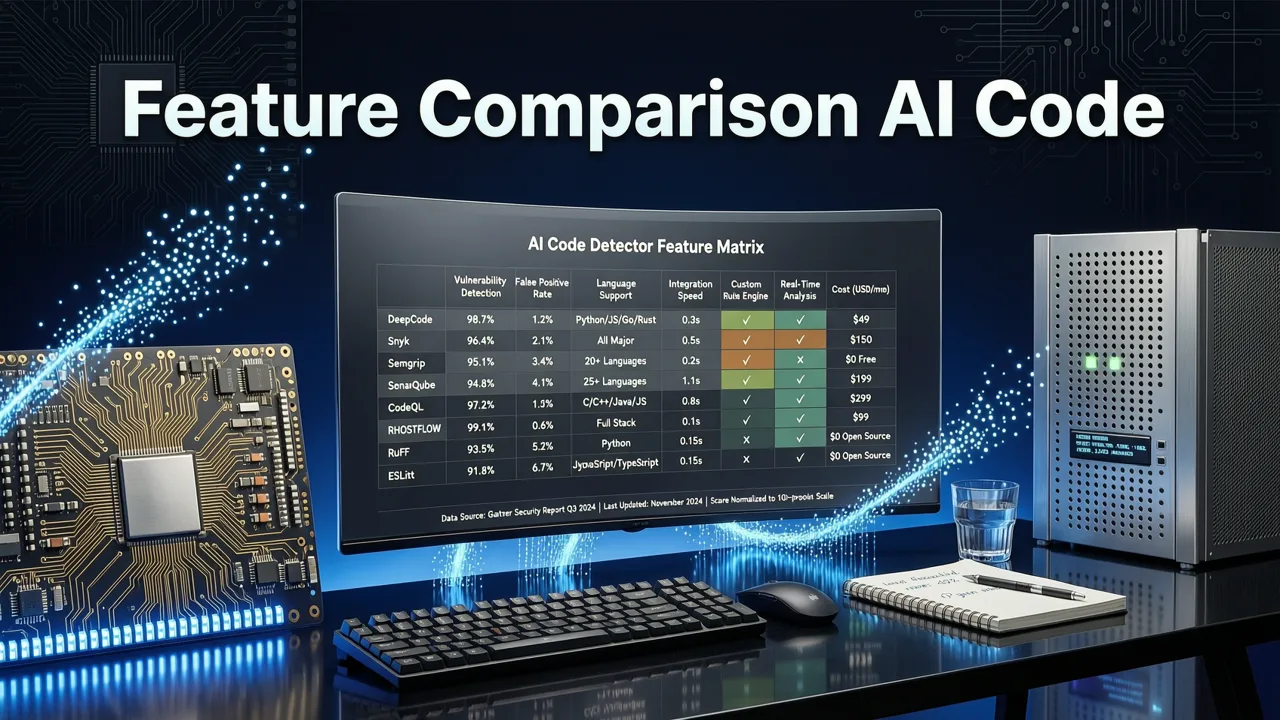
Selecting the right platform depends on your specific workflow, team size, and integration requirements. The following table compares the core capabilities of the leading tools in the market.
| Tool | Best For | Key Feature | Integration Level |
|---|---|---|---|
| GPTZero | Engineering Teams | CI/CD Pipeline API | High |
| Originality.ai | Code Reviewers | Deep File Scanning | Medium |
| Codequiry | Agencies & Freelancers | Originality Verification | Medium |
| Turnitin | Enterprise & Education | Repository Integration | High |
| Winston AI | Small Agencies | Multi-Language Support | Low |
| Smodin | Individual Developers | Quick Snippet Checks | Low |
| ZeroGPT | Quick Audits | Accessible Free Tier | Low |
How to Evaluate AI Code Detection Accuracy
When assessing these platforms, accuracy is the primary metric, but it must be understood in context. AI code detection relies on identifying statistical anomalies in syntax and logic flow. According to OpenAI documentation, understanding the underlying generation probabilities is key to improving detection methods, as models become more adept at mimicking human coding styles.
Look for tools that offer low false-positive rates. A high false-positive rate can frustrate development teams by flagging clean, human-written boilerplate as machine-generated. Additionally, consider the tool's support for your specific tech stack. A detector trained primarily on Python may struggle to accurately assess complex React or Next.js component logic. Context window limits are also crucial; tools that only analyze small snippets may miss broader architectural patterns that indicate AI generation.
Mitigating Risks Beyond Detection
Detection is only one part of a comprehensive code management strategy. Frameworks like Google AI guidance emphasize responsible deployment, which includes verifying the integrity, security, and performance of automated outputs. AI-generated code can inadvertently introduce security vulnerabilities, such as SQL injection flaws or improper data handling, because the model prioritizes functional syntax over secure practices.
To manage these risks, teams should combine detection tools with automated security scanning, rigorous peer reviews, and standardized testing protocols. If you want a deeper dive into identifying machine-written syntax and managing these risks, read our How to Detect AI Generated Code in 2026: A Complete Guide.
Building Clean Code from the Start
The most effective way to reduce the need for heavy AI code detection is to ensure the AI code you generate is clean, structured, and production-ready from the very beginning. When you use a high-quality AI website builder, the output is governed by strict templating and best-practice guidelines, minimizing the hallucinated logic and bloated syntax that detection tools frequently flag.
For teams looking to avoid messy outputs entirely, starting with a structured environment like a Tailwind AI Website Builder ensures the generated foundation is already production-ready. By leveraging utility-first CSS and modern frameworks like Next.js, the resulting code is inherently more readable and maintainable.
Furthermore, learning how to Create a Website With AI Prompt: The Complete 2026 Guide can help you write better prompts that yield cleaner, more predictable code. When your prompts are specific and structured, the AI generates targeted, efficient logic rather than generic, bloated scripts that trigger detection alarms.
Conclusion
The landscape of AI-generated code requires a proactive approach to quality assurance. The best AI code detector tools provide a vital safety net, helping teams identify machine-written syntax, mitigate security risks, and maintain technical standards. However, detection should be paired with responsible generation practices. By utilizing structured AI builders and crafting precise prompts, you can produce high-quality, production-ready code that minimizes the need for extensive remediation.
Ready to build clean, production-ready websites without the technical debt? Explore how ZyloCode transforms your text prompts into fully editable Next.js and Tailwind projects, giving you complete control over your codebase from day one.


