

On this page
12 sectionsBrowse the main headings and deeper subtopics from this article.
Recommended next
What Defines an AI Coding Assistant That Builds Websites?
If you are looking to launch a digital product, the search for an ai coding assistant that builds websites usually ends in frustration with walled-garden platforms or basic template generators. The reality of web development in 2026 is that founders, freelancers, and agencies no longer have to choose between the speed of no-code tools and the flexibility of custom engineering. A true AI coding assistant bridges this gap by translating natural language prompts directly into production-ready frameworks like Next.js and Tailwind CSS.
Unlike legacy builders that trap your design in proprietary drag-and-drop environments, modern AI web development tools generate clean, editable source code. This means you get the rapid deployment of a text-to-website generator combined with the long-term scalability of a pro-code environment. You can live-preview your application, refine the logic in a built-in code editor, and export the exact files needed to host the project anywhere.
The Technical Pipeline: From Text Prompt to Production Code
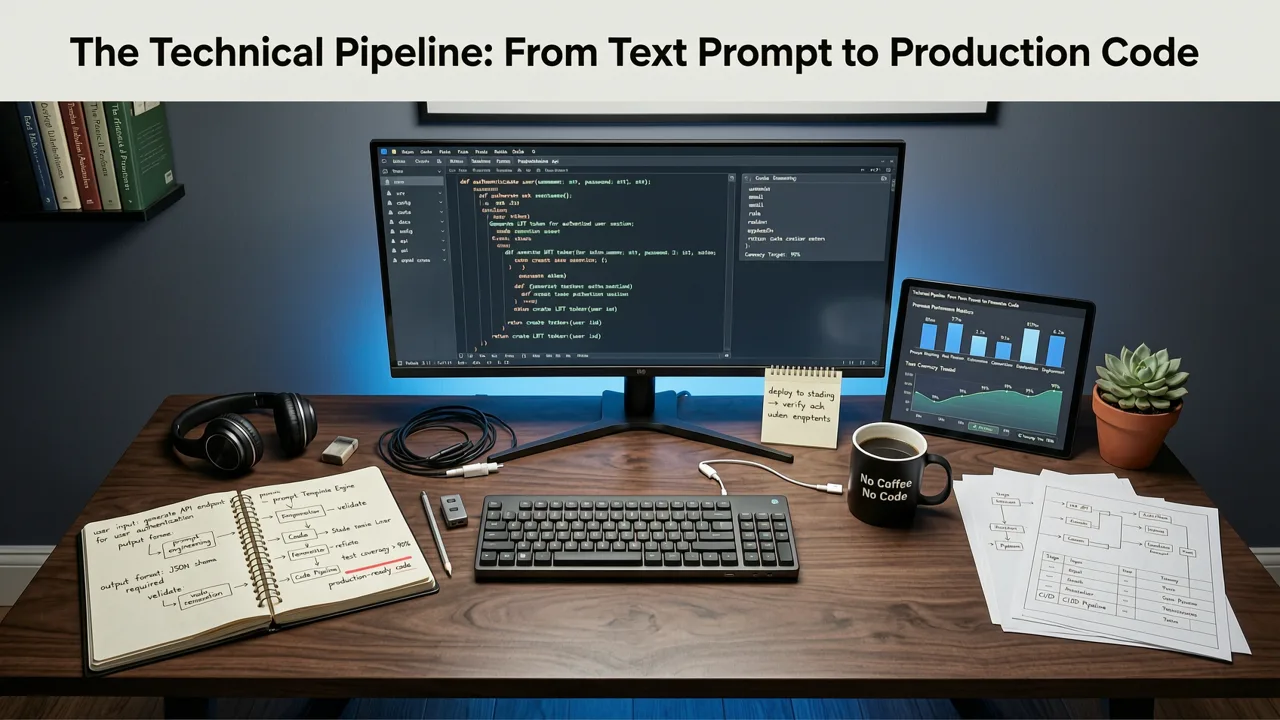
Understanding how these systems operate requires looking past the marketing hype and examining the underlying architecture. When you input a prompt, the AI does not merely stitch together pre-made HTML blocks. Instead, it leverages advanced large language models to construct a complete component tree.
The process begins with semantic parsing. The AI analyzes your prompt to determine the required layout, state management, and data-fetching patterns. According to foundational documentation from providers like OpenAI, modern models are fine-tuned to understand complex software architecture, allowing them to map user intent to specific React components and utility classes.
Once the structure is defined, the system generates the corresponding Next.js pages and Tailwind CSS styling. This prompt-to-code pipeline ensures that the output is not just a static visual mockup, but a fully functional application. The AI handles the boilerplate, configures the routing, and implements responsive breakpoints automatically, leaving you to focus on refining the core business logic.
Essential Features of a High-Performance AI Builder
Not all tools marketed as AI builders are created equal. Many still rely on outdated block-based systems that fail under the scrutiny of modern web standards. To evaluate whether a platform is a genuine AI coding assistant that builds websites, you must compare its feature set against the demands of production environments.
| Feature Category | Basic AI Generators | Advanced AI Coding Assistants |
|---|---|---|
| Output Format | Proprietary HTML/CSS blobs | Clean Next.js and Tailwind CSS code |
| Code Access | Locked inside the platform | Full source code export and built-in editor |
| Responsiveness | Basic mobile scaling | True mobile-first utility class generation |
| State Management | None (static pages only) | Dynamic React state and API integrations |
| Deployment | Platform-specific hosting only | One-click deploy or export to any host |
The distinction is clear: basic generators create digital brochures, while advanced assistants build production-ready web apps. When evaluating tools, prioritize platforms that offer full code access and utilize modern utility-first CSS frameworks.
Matching the Tool to Your Operational Goals
The value of an AI coding assistant varies depending on your operational scale and technical requirements. Founders typically use these tools to validate ideas and launch MVPs in hours rather than months, bypassing the initial development bottleneck entirely.
Freelancers benefit from the ability to deliver high-fidelity, custom-coded sites to clients without spending weeks writing boilerplate. For small agencies scaling their output, evaluating the best ai website builder for agencies in 2026 requires looking at multi-tenant management, code export capabilities, and the ability to maintain brand consistency across multiple client projects.
By leveraging a platform that outputs standard Next.js code, agencies can hand off projects to in-house development teams for complex backend integrations, ensuring the AI-generated foundation does not become a technical debt trap.
Crafting Effective Prompts for Complex Web Applications
The quality of the generated code is directly tied to the precision of your input. Writing a successful prompt is an iterative process that requires specificity regarding layout, component hierarchy, and design systems.
Instead of asking for a "modern landing page," a highly effective prompt specifies the exact sections, the desired visual hierarchy, the color palette constraints, and the interactive elements required. For instance, detailing that a hero section needs a two-column layout with a sticky navigation bar and specific Tailwind color tokens yields vastly superior results.
To maximize output quality and avoid common pitfalls, reading a comprehensive guide on how to create a website with an AI prompt in 2026 is highly recommended. Mastering prompt engineering for code generation transforms the AI from a simple typing assistant into a collaborative senior developer.
Prioritizing Responsiveness and Modern Design Standards
In an era where mobile traffic dominates, responsiveness cannot be an afterthought. A capable AI coding assistant that builds websites must inherently understand mobile-first design principles. This means generating Tailwind classes that prioritize smaller viewports first, using flexible grids, and ensuring touch targets are appropriately sized.
When your primary goal is conversion, utilizing a dedicated AI responsive landing page generator ensures mobile-first compliance and optimized load times. These specialized tools focus on generating lightweight, highly performant components that score perfectly on core web vitals, ensuring your AI-generated site ranks well and retains users.
Navigating AI Ethics and Responsible Generation
As AI becomes deeply embedded in the software development lifecycle, responsible usage is paramount. Generating code that is accessible, secure, and free from biased content is a shared responsibility between the platform provider and the user.
Adhering to responsible AI practices, as outlined in Google's AI responsibility guidelines, ensures that generated code respects accessibility standards, such as proper ARIA labels and semantic HTML structures. Furthermore, responsible platforms implement guardrails to prevent the generation of insecure code patterns or copyrighted material, protecting both the developer and the end-user.
Maintaining Code Ownership and Long-Term Flexibility
The most critical advantage of using a modern AI coding assistant is the preservation of code ownership. Traditional no-code platforms lock you into their ecosystem, charging exorbitant fees if you wish to scale or migrate. In contrast, tools that export standard Next.js and Tailwind CSS code give you complete sovereignty over your digital assets.
Transitioning to a true Tailwind AI website builder gives you the no-code speed with full code access. You can host the application on your own infrastructure, integrate it with any third-party service, and modify the codebase using your preferred IDE. This flexibility ensures that your website can evolve alongside your business without being constrained by platform limitations.
The Business Case for AI-Assisted Development
Integrating an AI coding assistant into your workflow is not just a technical upgrade; it is a strategic business decision. The reduction in time-to-market allows teams to test hypotheses faster, iterate based on real user feedback, and allocate engineering resources to complex, high-value problems rather than repetitive UI construction.
By automating the generation of production-ready components, organizations can significantly reduce their reliance on external development agencies for routine web projects. This shift in resource allocation drives down operational costs while simultaneously increasing the volume and quality of digital outputs.
Conclusion
The landscape of web development has permanently shifted. An AI coding assistant that builds websites is no longer a futuristic concept but a practical necessity for anyone looking to compete in 2026. By choosing a platform that generates clean, exportable Next.js and Tailwind code, you secure the perfect balance of rapid deployment and long-term technical flexibility.
Ready to experience the next generation of web development? Explore how ZyloCode transforms your text prompts into production-ready applications, giving you full code access and one-click deployment to launch your next project with confidence.


