

On this page
8 sectionsBrowse the main headings and deeper subtopics from this article.
Recommended next
An AI code detector API is a hosted endpoint that accepts source code and returns a probability score — often with line-level or segment-level detail — estimating how much of that code looks machine-generated. In 2026, nearly every provider exposes a straightforward REST/JSON contract, so a working integration is typically a day of engineering rather than a research project.
Here is the short answer if you are ready to buy: pick a provider that supports your languages and typical snippet length, confirm its data-retention terms in writing, send normalized code over HTTPS with a bearer token, and treat the returned score as a routing signal for human review, not a verdict. The rest of this guide covers vendor selection, the request/response contract, threshold policy, and the pre-merge wiring that keeps the whole thing from annoying your team.
What an AI Code Detector API Actually Returns
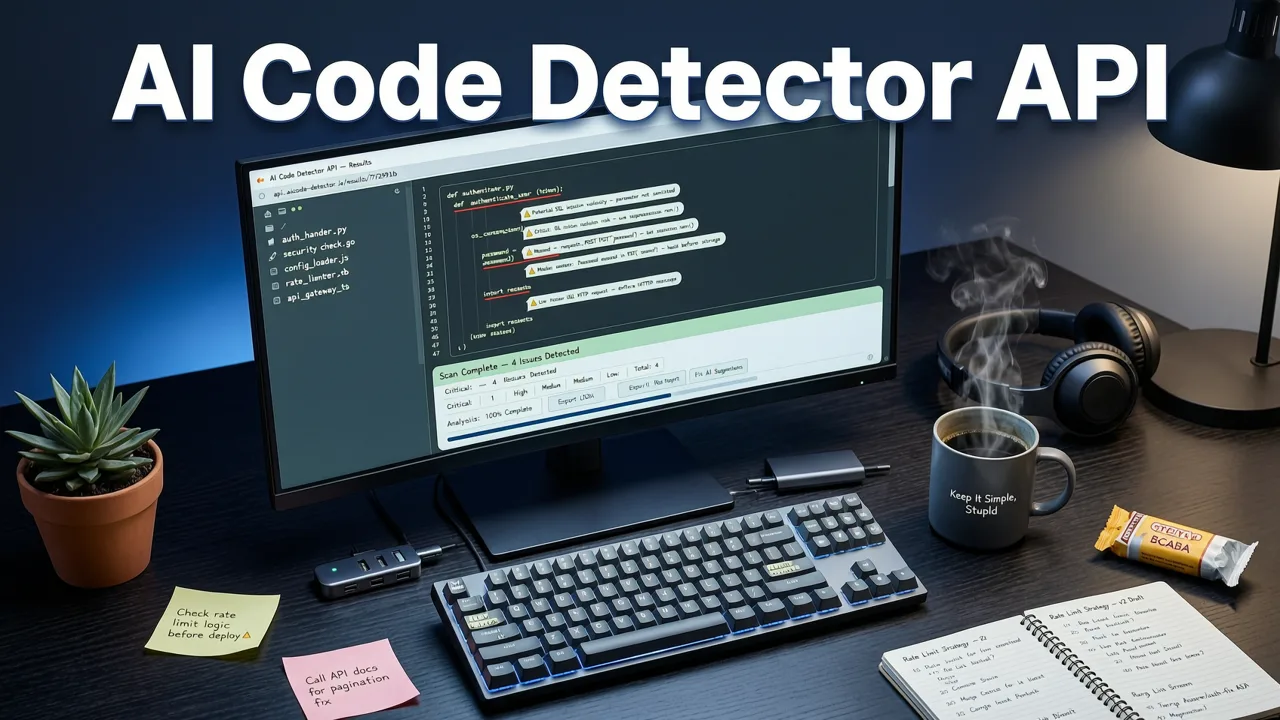
Detection services do not compile your code, run it, or reason about whether it is correct. They tokenize source files as structured text and score statistical patterns: identifier naming habits, comment density and phrasing, formatting regularity, repetition of idiomatic blocks, and how predictable the next token is under a reference model.
The contract: code in, probability out
Most implementations converge on the same shape, which makes swapping providers far easier than it was a few years ago:
- Input: a code string or file array, a language hint, and optional metadata such as repository name and commit SHA.
- Output: an overall probability (0–1 or 0–100), a confidence or signal-strength field, and per-segment scores when granularity is requested.
- Metadata: a model or detector version string, token/character counts billed, and a request ID for support and auditing.
- Async paths: batch endpoints or webhooks for whole-repository scans that exceed synchronous timeouts.
Why the score is a signal, not proof
Classifiers produce false positives on heavily templated code — boilerplate configuration, CRUD handlers, generated types, utility class strings — and false negatives on AI output that a human refactored. Framework-heavy files are especially noisy. If you want the underlying mechanics before you commit budget, this explainer on whether AI detectors can read source code covers how parsing differs from semantic understanding.
Practical consequence: never let a single score trigger an automated accusation, a rejected invoice, or a blocked release. Use it to decide what a human looks at next.
How to Choose an AI Code Detector API in 2026
There are four realistic buying paths, and they differ more in operational cost than in headline accuracy. Match the option to the decision you actually need to make.
| Option | Deployment | Typical strength | Main trade-off | Best fit |
|---|---|---|---|---|
| Dedicated code-detection API | Hosted REST, key-based auth | Code-specific training, segment scoring, batch scans | Usage cost scales with repo size | Agencies and platforms scanning client or contributor code |
| General AI-content platform with code support | Hosted REST, shared quota with prose detection | One vendor for docs, copy, and code | Code handling may be shallower than prose handling | Teams already paying for content detection |
| Self-hosted open-weight classifier | Your container or GPU node | Code never leaves your network; no per-call fee | You own uptime, tuning, and model updates | Regulated codebases and strict data-residency rules |
| LLM-based heuristic review | Prompted model call in your pipeline | Explainable rationale alongside a judgement | Non-deterministic, prompt-sensitive, harder to calibrate | Advisory notes in code review, not gating |
For a tool-by-tool view of the current market, the roundup of the best AI code detector tools for 2026 is a useful shortlist companion to the criteria below.
Pricing models you will encounter
- Per request: predictable for file-level checks, expensive if you send thousands of tiny snippets.
- Per character or per token: fairer for large files; budget by bytes scanned per month, not by seat count.
- Subscription plus quota: a fixed monthly allowance with overage rates — check whether unused quota rolls over.
- Self-hosted compute: no licence fee per call, but inference hardware and maintenance become your line item.
Ask every vendor for a cost estimate based on your real repository size and scan frequency. A cheap per-call price can become the most expensive option once you scan a monorepo on every pull request.
Evaluation checklist before you sign
- Language coverage: confirm explicit support for TypeScript, JavaScript, Python, and whatever else you ship — not just "code".
- Minimum input length: find the documented floor below which scores are unreliable, and enforce it client-side.
- Determinism: does the same input return the same score when you pin the detector version?
- Granularity: file-level only, or function/line ranges you can surface in a review comment?
- Rate limits and concurrency: requests per minute, burst behaviour, and batch ceilings.
- Retention and training terms: is your code stored, for how long, and is it excluded from model training by default?
- Versioning and deprecation policy: how much notice you get before scoring behaviour changes.
- Exit cost: can you export historical results, or does your compliance record live only in their dashboard?
Integrate an AI Code Detector API: Step-by-Step
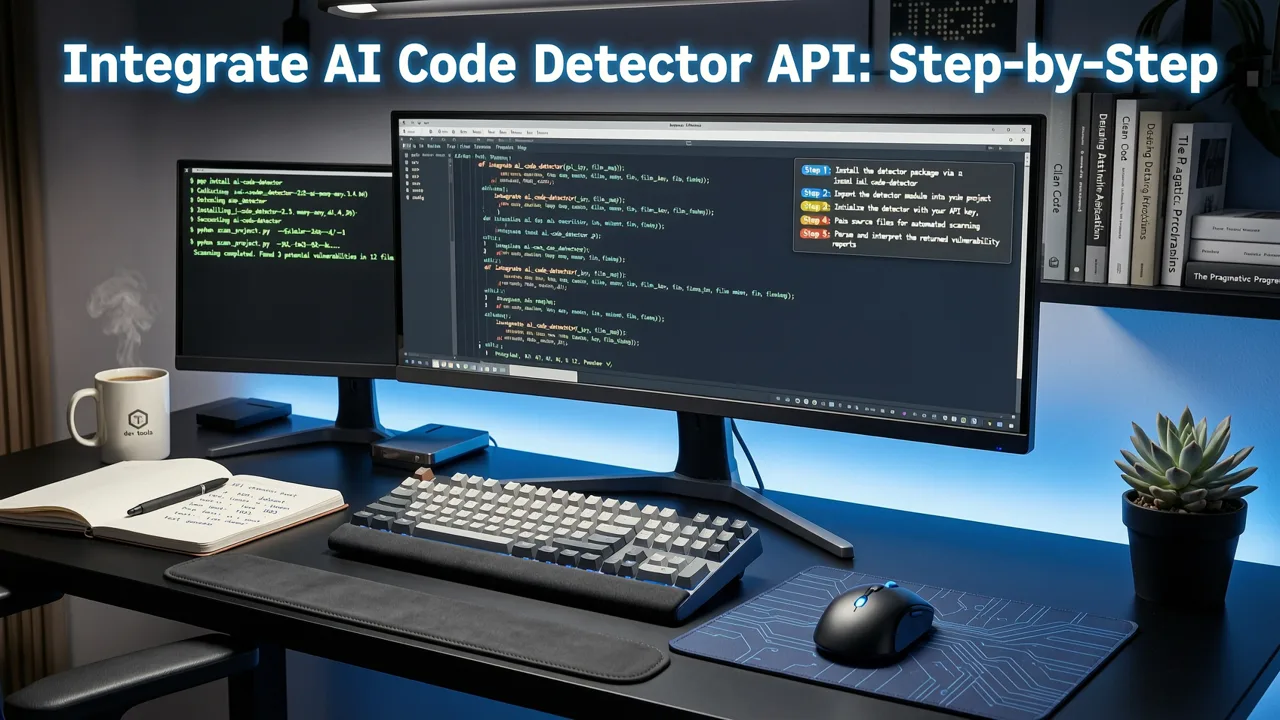
The sequence below assumes a hosted REST provider and a Git-based workflow. Adjust the transport details to your vendor's documentation, but keep the order — most failed integrations skip steps one and three.
- Define the decision first. Write one sentence: "Flag pull requests where generated code exceeds a threshold so a reviewer checks licensing and correctness." If you cannot name the human action, you do not need the API yet.
- Provision a sandbox key. Use a separate key for development, store it in your secret manager, and never embed it in client-side code or a public repository.
- Normalize the input. Exclude lockfiles, minified bundles, build output, snapshots, generated API clients, and vendored dependencies. Send hand-authored source only, or your false positive rate will be dominated by machine-formatted text that nobody wrote.
- Chunk sensibly. Split by file or function rather than arbitrary character windows, so segment scores map to something a reviewer can open.
- Send the request. POST JSON over HTTPS with an authorization header, an explicit language field, a pinned detector version, and your chosen granularity.
- Validate and store the response. Persist score, confidence, detector version, request ID, and commit SHA together. A score without a version and a commit is not auditable later.
- Apply a threshold policy. Route results into buckets (see the table below) instead of a single pass/fail boolean.
- Wire it into CI as advisory. Post a pull-request comment with the flagged ranges. Run the gate in warn-only mode for a few weeks before anyone considers blocking.
- Review calibration monthly. Sample flagged and unflagged files, track how often reviewers agree, and adjust thresholds or exclusions rather than trusting the default forever.
Request fields worth setting explicitly
| Field | Why it matters | Practical tip |
|---|---|---|
| Language | Language-specific models score differently | Derive from file extension; never rely on auto-detect for mixed files |
| Detector version | Scores drift between model releases | Pin it, and record it with every stored result |
| Granularity | Determines whether output is actionable | Request segment ranges when the provider supports them |
| Minimum length / confidence | Short inputs produce noise | Skip files below the documented floor and log them as "insufficient signal" |
| Idempotency key | Prevents duplicate billing on retries | Use commit SHA plus file path plus version |
| Callback URL | Enables large batch scans | Verify webhook signatures before trusting payloads |
Timeouts, retries, and cost control
Treat the detector like any third-party dependency: a hard client timeout, exponential backoff with jitter, and a circuit breaker so an outage never stalls your pipeline. Retry only on transient failures; respect Retry-After on throttling responses. The MDN web docs remain the cleanest reference for HTTP status semantics and caching headers if your team needs a refresher.
- Cache by content hash. Unchanged files should never be re-billed on every push.
- Scan diffs, not the whole repo. Pull-request scope covers most real decisions at a fraction of the cost.
- Cap concurrency. Stay under the documented rate limit instead of discovering it through 429s.
- Fail open. If the API is down, log "unknown" and let review proceed. Detection is advisory infrastructure, not a build dependency.
Fitting Detection Into a Real 2026 Build Pipeline
Generated code is now normal. A founder shipping a marketing site or a dashboard from a prompt is not doing anything unusual, and an AI-built Next.js and Tailwind codebase is not inherently lower quality than a hand-typed one. If you are evaluating that workflow itself, this guide to an AI coding assistant that builds websites explains what a prompt-to-production pipeline actually produces.
That reframes the purpose of an AI code detector API. The useful question is rarely "was a machine involved?" It is "does this code carry provenance, licensing, security, or maintainability questions that need a human answer?" Detection is one input to that review, alongside tests, type checks, dependency scanning, and a readable diff.
A pre-merge policy people will accept
| Score band | Signal strength | Action | Blocks merge? |
|---|---|---|---|
| Low | Any | Log silently for trend analysis | No |
| Mid | High | Advisory PR comment with flagged ranges | No |
| High | High | Require a named reviewer sign-off on provenance and licence checks | Only by human decision |
| Any | Low / input too short | Mark "insufficient signal", skip scoring | No |
Notice what is absent: automatic rejection. A policy that blocks merges on a probabilistic score will be disabled within a sprint, and you will lose the audit trail along with it.
Typed contracts reduce breakage
Define the response shape as an interface or schema and validate it at runtime before your logic touches it. Optional fields appear and disappear between detector versions, and a strict type layer surfaces that immediately instead of producing silent undefined scores. The TypeScript documentation covers narrowing and discriminated unions, which map neatly onto "scored", "insufficient signal", and "error" result states.
Mistakes That Break AI Code Detection Integrations
- Scoring generated artifacts. Lockfiles, compiled output, and snapshot tests are machine-written by definition and will skew every aggregate you report.
- Aggregating to a single repo percentage. Averaging across thousands of heterogeneous files produces a number nobody can act on. Report per file and per pull request.
- Ignoring boilerplate-heavy frameworks. Repetitive config and utility-class markup look statistically predictable regardless of authorship. Maintain an exclusion list.
- Unpinned versions. A silent model update changes your historical baselines and invalidates comparisons.
- Secrets in the wrong place. Detection calls belong on the server or in CI, never in browser code where a key can be extracted.
- Treating scores as evidence of misconduct. Without a documented policy and human review, you create disputes you cannot substantiate.
- No fallback path. If the vendor rate-limits you mid-release, the pipeline should degrade gracefully rather than fail.
Privacy, Retention, and Procurement Questions
You are sending proprietary source code to a third party. That deserves the same scrutiny as any data processor, especially for agency work where client contracts may prohibit it outright.
- Retention window: how long is submitted code stored, and can you request zero retention?
- Training exclusion: is your input excluded from model training by default, in writing?
- Region and residency: can processing be pinned to a specific jurisdiction?
- Sub-processors: who else touches the payload, and where?
- Deletion and export: can you purge stored code and export your result history on exit?
- Client permission: does your engagement letter allow third-party code analysis at all?
If any answer is unacceptable, a self-hosted classifier is the honest fallback. You trade convenience for control, and you keep the code inside your own boundary.
Start Narrow, Then Expand
A successful AI code detector API integration is deliberately modest: one clear decision, diff-scoped scans, pinned versions, cached results, advisory output, and a human owner for every flag. Get that running, measure how often reviewers agree with the scores, and only then consider widening coverage or tightening policy. Buying accuracy you cannot calibrate is the most common way this budget gets wasted.
If your underlying goal is shipping a real, editable website faster, start at the source: ZyloCode turns text prompts into production-ready Next.js and Tailwind code you can live-preview, refine in a built-in code editor, and deploy in one click or export outright. Begin on the free Hobby tier, review the generated code as you would any contribution, and move up to Pro or Enterprise when your workflow demands it.
Tailwind CSS with AI
Start with Tailwind AI website builders.
Apply the playbook
Ready to build your website?
Describe the site you need and ZyloCode writes it in React and Tailwind, with a live preview and a code editor.
Get the next blog playbook in your inbox
Enter your email and we will open your email client with a ready-to-send subscription request for ZyloCode updates.
Previous article
7 Best AI Code Detector Tools for 2026
Discover the 7 best AI code detector tools for 2026. Compare features, accuracy, and pricing to find the right solution for your development team.
Next article
Can AI Detectors Read Source Code? 2026 Guide
Can AI detectors read source code? Yes, but with limits. Learn how code detection works in 2026, what probability scores mean, and where tools fail.
Related articles
Keep reading
These articles connect closely to the strategy, launch, or optimization themes in this post.

Can AI Detectors Read Source Code? 2026 Guide
Can AI detectors read source code? Yes, but with limits. Learn how code detection works in 2026, what probability scores mean, and where tools fail.


