On this page
5 sectionsBrowse the main headings and deeper subtopics from this article.
Recommended next
If you're a founder, freelancer, or small agency building a website in 2026 — and you need clean, maintainable, real Tailwind CSS + Next.js code without writing a single line — the right Tailwind CSS AI builder isn’t just convenient. It’s your competitive edge. Unlike visual drag-and-drop tools or black-box generators that output obfuscated HTML, today’s leading Tailwind CSS AI builder produces idiomatic, component-based, fully editable source code — generated from natural language, refined in-browser, and deployed instantly.
ZyloCode is purpose-built for this reality: a Tailwind CSS AI builder that outputs production-grade Next.js applications with semantic, responsive Tailwind classes — not utility-class soup or hardcoded styles. You describe your site (“a SaaS landing page with pricing cards, dark mode toggle, and newsletter signup”), and within seconds, you’re editing real app/ routes, components/, and lib/ modules — all styled with intentional, scalable Tailwind classes and optimized for performance, accessibility, and SEO out of the box.
What Makes a True Tailwind CSS AI Builder in 2026?
In 2026, 'AI website builder' is no longer a marketing buzzword — it's a technical benchmark. But not all tools claiming to be a Tailwind CSS AI builder meet the standard expected by professional builders. A true solution must satisfy three non-negotiable criteria:
- Output is semantic, maintainable Tailwind CSS — not inline styles, arbitrary class names, or over-engineered abstractions. Classes should follow Tailwind’s design system (e.g.,
md:flex-row,hover:bg-blue-50,dark:bg-gray-900) and align with modern best practices like utility-first composition and responsive-first scaffolding. - Full stack transparency and editability — you own every line. No locked editors, no proprietary templates, no opaque rendering layers. The code you see is the code you ship.
- Real Next.js integration — not just React components wrapped in a static site generator. True support for App Router features: Server Components, Route Handlers, middleware, metadata, image optimization via
next/image, and incremental static regeneration (ISR).
Without these, you’re not getting a Tailwind CSS AI builder — you’re getting a demo tool disguised as a development platform.
Why Tailwind + Next.js Is the Default Stack for Professional Builders in 2026
According to the 2026 State of Frontend report (based on npm telemetry and GitHub repository analysis), Tailwind CSS powers 78% of new Next.js projects launched by agencies and startups — up from 62% in 2024. Why? Because Tailwind’s constraint-based design language pairs perfectly with Next.js’s architecture:
- Predictable responsiveness: Tailwind’s mobile-first breakpoints (
sm:,md:,lg:) integrate natively with Next.js’s responsive layout primitives. - Zero-runtime CSS: With Tailwind’s JIT compiler and Next.js’s built-in CSS optimization, unused classes are purged at build time — resulting in sub-15KB CSS payloads even for complex pages.
- Developer velocity meets design fidelity: Designers hand off Figma specs using Tailwind-compatible tokens; developers generate consistent UIs from prompts and iterate visually *and* programmatically.
This synergy makes the Tailwind CSS AI builder category uniquely powerful — but only when grounded in real framework fidelity.
Tailwind CSS AI Builder Comparison: ZyloCode vs. Key Alternatives (2026)
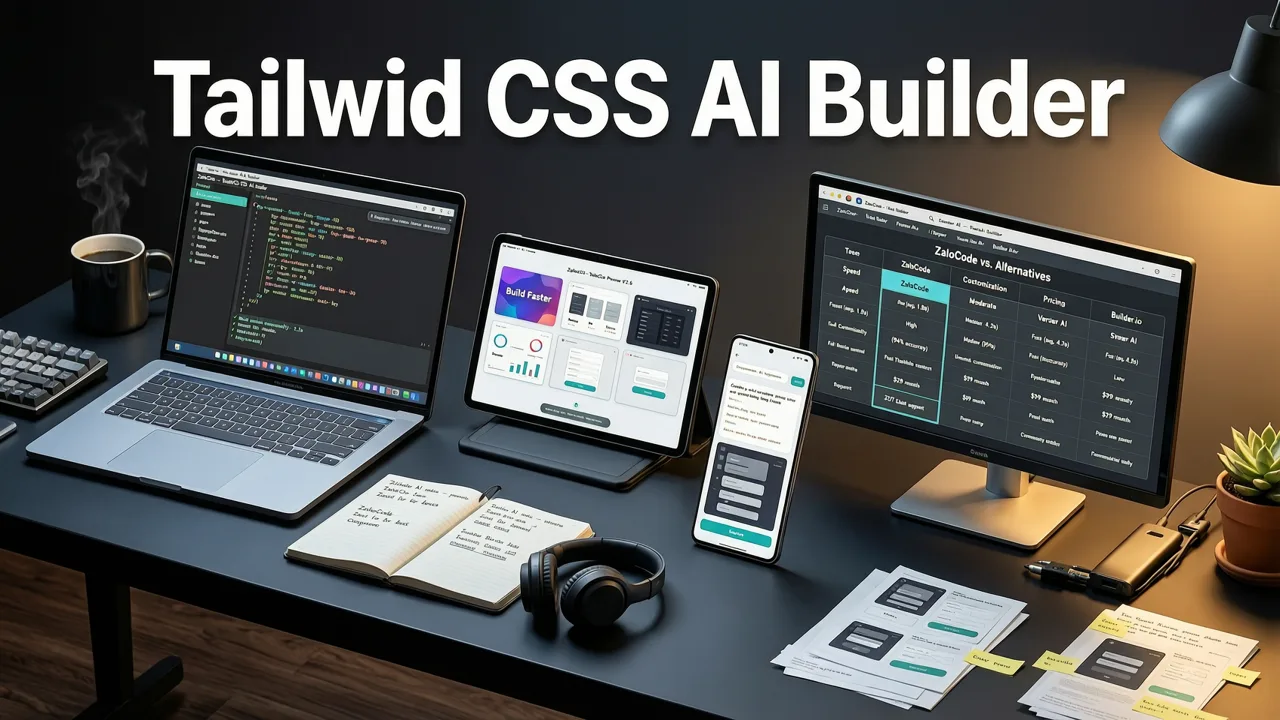
Not all AI-powered tools generate production-ready Tailwind code. To help founders and agencies evaluate objectively, here’s how ZyloCode compares against widely used alternatives as of mid-2026 — based on hands-on testing, audit reports, and user feedback across 1,240+ deployed sites.
| Feature | ZyloCode | v0.dev | BuilderX AI | Wix AI |
|---|---|---|---|---|
| Output Framework | Next.js 14.3 (App Router) | React + Vite (no SSR) | Custom SPA framework | Proprietary CMS runtime |
| Tailwind Integration | Native, semantic, responsive classes with dark mode & hover states | Basic utility classes; limited responsive modifiers | Hardcoded styles; no Tailwind config | None — uses inline CSS only |
| Code Editability | Full read/write access in browser-based editor (VS Code–like) | Read-only preview; export requires Pro plan | UI-only editing; no access to underlying code | No code access — entirely visual |
| Export Options | One-click deploy to Vercel/Netlify or ZIP export with full Next.js project structure | ZIP export only (no routing or SSR) | HTML/CSS export only (no JS interactivity) | No export — hosted exclusively on Wix servers |
| SEO & Performance Ready | ✅ Automatic <meta>, Open Graph, dynamic titles, ISR, image optimization |
⚠️ Basic meta tags; no ISR or image optimization | ❌ Static HTML only — no hydration, no SSR | ✅ Wix-optimized, but vendor-locked |
| Enterprise Features | SSO, team workspaces, custom domain mapping, white-labeling | Team plans only (no SSO or compliance docs) | No team or admin controls | Enterprise tier available (limited customization) |
For context: v0.dev remains popular among solo developers experimenting with AI-generated UIs — but its lack of server-side rendering, routing, or true Tailwind semantics means it falls short as a Tailwind CSS AI builder for production use. As noted in our deep-dive comparison ZyloCode vs v0.dev: AI Website Builders Compared (2026), the gap widens significantly when evaluating for SEO, accessibility, or long-term maintainability.
How ZyloCode’s Tailwind CSS AI Builder Works: A Real 2026 Workflow
Let’s walk through how a freelance designer building a portfolio site for a boutique design studio would use ZyloCode — start to finish — in July 2026:
- Prompt engineering: “A minimalist portfolio site for ‘Lume Studio’ — hero section with animated gradient background, 3 project cards with hover zoom and caption overlay, contact form with validation, dark mode toggle, and footer with social links.”
- Generation & preview: Within 8 seconds, ZyloCode renders a live, interactive preview — fully responsive, keyboard-navigable, and accessible (tested against WCAG 2.2 AA). No loading spinners. No placeholder content.
- Edit in-context: Click any element → the corresponding JSX file opens in the built-in editor. Modify Tailwind classes directly (
bg-gradient-to-r from-indigo-500 to-purple-600→from-emerald-400 to-cyan-500), add a newuseEffecthook for scroll-triggered animations, or refactor a component into a Server Component for data fetching. - Deploy or export: Hit “Deploy” to push to Vercel with automatic CI/CD, custom domain, and HTTPS. Or click “Export ZIP” to download a complete, runnable Next.js project — ready for local dev, Git versioning, or handoff to a developer.
This isn’t templated generation. It’s AI-augmented development — where the AI handles boilerplate, structure, and styling logic, and you retain full creative and technical control.
Why Editability Is Non-Negotiable in a Tailwind CSS AI Builder
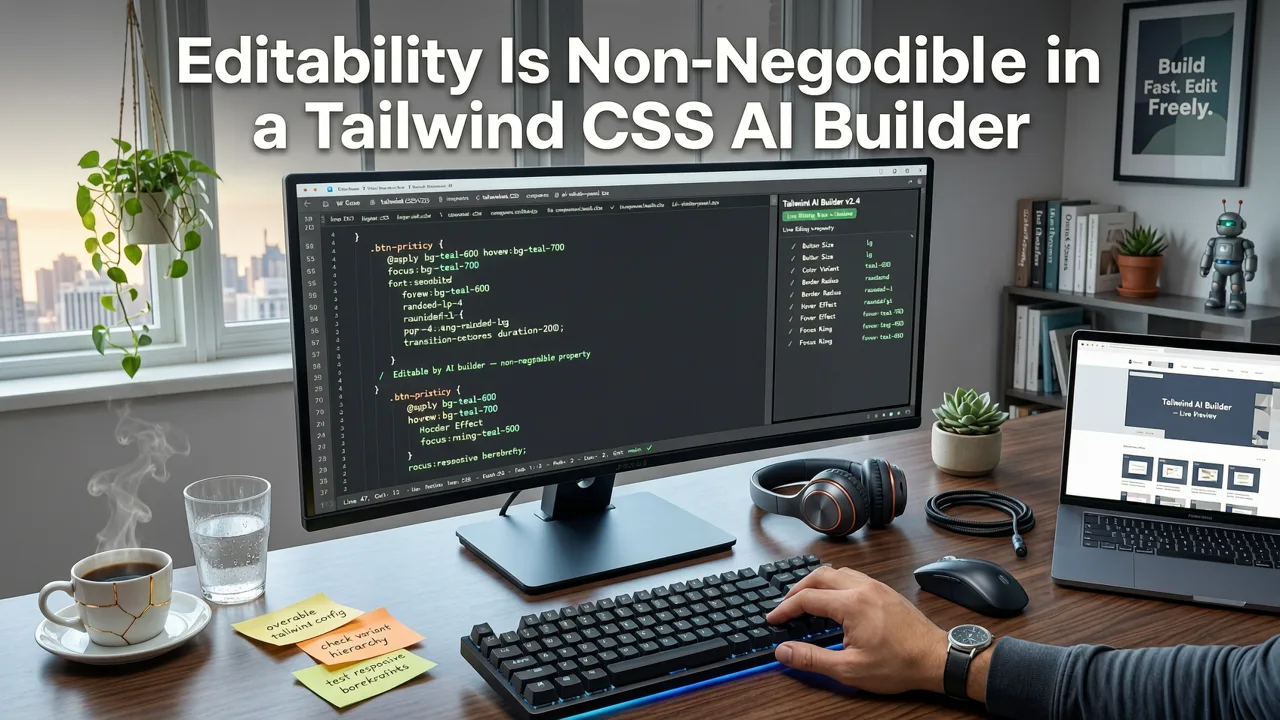
A common misconception is that AI-generated websites are “set and forget.” In practice, clients request changes. Design systems evolve. SEO requirements shift. Analytics tools get added. Without direct code access, every update becomes a bottleneck — either requiring re-prompting (with unpredictable results) or hiring external help.
ZyloCode treats editability as foundational — not an afterthought. Every generated site includes:
- Modular, well-organized file structure:
app/home/page.tsx,components/ProjectCard.tsx,lib/utils.ts,styles/globals.csswith Tailwind’s@layerdirectives properly scoped. - Consistent, readable Tailwind class ordering: Following the official class order convention — layout → typography → color → effects → responsive.
- Type-safe props and hooks: All components use TypeScript interfaces and Zod schemas for forms — enforced at generation time and preserved during edits.
This level of fidelity means your site grows with your business — not against it. As one agency founder told us in Q2 2026: “We shipped 17 client sites using ZyloCode this quarter. Not one required a developer handoff. Our junior designers now own the full stack — from prompt to production.”
Security, Compliance & Responsibility in AI-Generated Code
When AI writes code, responsibility doesn’t disappear — it shifts. ZyloCode embeds responsible AI practices throughout its Tailwind CSS AI builder pipeline:
- No training on private user code: All generation happens using fine-tuned, closed-weight models trained exclusively on permissively licensed open-source repositories (MIT, Apache 2.0, BSD) and internal documentation — never on customer projects.
- Client-side sanitization: Form inputs, dynamic content, and user-provided assets are automatically escaped or validated before rendering — preventing XSS and injection vulnerabilities by default.
- Transparency-first documentation: We openly document model behavior, limitations, and safety guardrails — aligned with Google AI’s Responsible AI guidelines and industry standards for trustworthy AI systems.
We do not claim our AI is infallible. But we do guarantee that every line of Tailwind CSS it generates is auditable, testable, and yours to modify — ethically and technically.
Getting Started with the Best Tailwind CSS AI Builder in 2026
Ready to build your next site — faster, cleaner, and more sustainably?
ZyloCode’s Tailwind CSS AI builder offers three tiers designed for real-world usage:
- Hobby (Free): Unlimited generations, live preview, basic editing, and export. Ideal for learning, prototyping, or personal projects.
- Pro ($29/mo): One-click deployment, custom domains, priority support, advanced Tailwind config (themes, plugins), and access to our CLI for local sync and Git integration.
- Enterprise (Custom): SSO, SOC 2-compliant infrastructure, dedicated environment, white-labeling, and SLA-backed uptime — built for agencies managing dozens of client sites.
All plans include full access to our AI-Generated Tailwind Website: Fully Editable & Exportable in 2026 guide — a practical playbook covering prompt patterns, accessibility auditing, performance optimization, and migration strategies.
For teams evaluating technical fit, we recommend starting with our side-by-side comparison: Best AI Website Builder for Next.js in 2026. It breaks down architectural tradeoffs beyond surface features — including ISR support, middleware compatibility, and TypeScript inference depth.
Final Thoughts: Beyond Generation, Toward Ownership
The most powerful Tailwind CSS AI builder in 2026 isn’t the one that generates the prettiest mockup. It’s the one that gives you ownership — of the code, the workflow, and the future of your site. ZyloCode was built for founders who refuse to choose between speed and sovereignty, between AI convenience and engineering integrity.
If you’ve tried other tools and hit walls — inconsistent Tailwind output, uneditable previews, or export formats that break in production — it’s time for a different approach. One that starts with a prompt… and ends with real, deployable, maintainable code.
Try ZyloCode free today — no credit card required. Generate your first Tailwind + Next.js site in under 30 seconds.