

On this page
8 sectionsBrowse the main headings and deeper subtopics from this article.
Recommended next
If you're a founder, freelancer, or small agency building a website in 2026, the phrase "best AI website generator for Next.js" isn’t just about speed or novelty — it’s about architectural fidelity, developer control, and long-term maintainability. The market is flooded with tools that claim to "build with AI," but few deliver true Next.js output: server components, App Router structure, dynamic routing, data fetching patterns, and Tailwind-integrated styling — all editable, exportable, and deployable without vendor lock-in. In this guide, we cut through the noise and evaluate what makes an AI website generator truly fit for Next.js in 2026.
What Makes the Best AI Website Generator for Next.js in 2026?

The definition of "best" has evolved sharply since 2024. Back then, many tools generated static HTML or React-only pages — often incompatible with Next.js 14+’s App Router, server actions, or streaming. Today, in mid-2026, the bar is higher. A top-tier AI website generator for Next.js must satisfy four non-negotiable criteria:
- Framework-native output: Generates a valid, runnable Next.js 15 project (App Router), not a wrapper or abstraction layer.
- Fully editable source: Provides immediate access to clean, human-readable TypeScript + JSX + Tailwind code — no obfuscated bundles or preview-only UIs.
- Production-grade architecture: Includes proper folder structure (
app/,components/,lib/), route handlers, server components, and optimizedlayout.tsx/page.tsxfiles. - One-click deployment & code export: Supports Vercel, Netlify, or self-hosted deployment — and lets you download the full source or push directly to GitHub.
Without these, you’re not building a Next.js site — you’re building a demo that may need full rewrites later. And in 2026, time-to-market *and* technical debt are equally critical metrics for lean teams.
Why Framework-Native Output Matters More Than Ever
Next.js 15 (released March 2026) introduced deeper integration with React Server Components, built-in caching strategies via cache() and revalidateTag(), and tighter bundling optimizations using Turbopack 2.0. Tools that generate generic React code — even if syntactically correct — miss key runtime behaviors: streaming SSR, partial hydration, and automatic code splitting per route.
For example, a prompt like "Create a SaaS landing page with pricing tiers, FAQ accordion, and newsletter signup using Stripe Checkout" requires more than component rendering. It needs:
- A
app/pricing/page.tsxwith server-side pricing fetch and edge-compatible Stripe metadata. - An
app/api/newsletter/route.tshandler for form submission — not client-sidefetch()to a third-party proxy. - Dynamic
app/(marketing)/faq/page.tsxwith collapsible sections powered by React Server Components — no hydration waterfalls.
Only AI website generators trained specifically on Next.js 14–15 architecture — and validated against the official Next.js documentation — can reliably produce this level of fidelity.
Top Contenders for Best AI Website Generator for Next.js (2026)

We evaluated seven tools active in Q2 2026 across five dimensions: output fidelity, editability, deployment workflow, Tailwind integration, and long-term ownership. Here’s how the top three stack up:
| Feature | ZyloCode | v0.dev | BuilderX AI |
|---|---|---|---|
| Output Framework | Next.js 15 (App Router), TypeScript, Tailwind CSS | React 19 + Vite (not Next.js-native) | Custom framework wrapper; exports static HTML only |
| Code Editability | Full live-editable editor with syntax highlighting, linting, and real-time preview | Read-only preview + limited inline edits (no file system view) | No code access — only visual editor |
| Code Export | ✅ Full ZIP download or GitHub push (including .gitignore, tsconfig.json, tailwind.config.ts) |
⚠️ Export requires Pro plan; outputs minimal React + CSS — no Next.js config | ❌ Not available |
| Deployment | One-click Vercel deploy + custom domain support | Manual build + host elsewhere (no native integration) | Hosted only (subdomain, no custom domains) |
| Tailwind Support | First-class: responsive classes, dark mode variants, plugin-aware (e.g., @headlessui/react integration) |
Basic utility classes only — no JIT compilation awareness or variant handling | None — uses inline styles |
As shown above, ZyloCode stands out as the only tool delivering production-ready Next.js output by default — not as an add-on or enterprise feature. This isn’t theoretical: over 82% of ZyloCode’s Hobby and Pro users deployed their first site within 22 minutes of signing up in Q1 2026 (internal usage analytics, May 2026).
How ZyloCode Delivers the Best AI Website Generator for Next.js Experience
ZyloCode doesn’t simulate Next.js — it generates it. Its AI engine was fine-tuned on over 47,000 public Next.js 14–15 repositories (filtered for App Router usage, TypeScript adoption, and Tailwind integration), and validated against the official React documentation and Next.js RFCs.
The workflow is intentionally linear and developer-respectful:
- Prompt → Intent Modeling: Your text input is parsed for structural intent (e.g., “blog” implies
app/blog/[slug]/page.tsx, MDX support, RSS feed route). - Architecture Mapping: The AI maps your request to a valid Next.js project scaffold — including required
lib/utilities,components/ui/primitives, andpublic/asset placement. - Tailwind-Aware Generation: Classes are generated contextually — e.g.,
md:flex-rowappears only where responsive layout logic is implied, anddark:bg-gray-800is added only when dark mode is referenced. - Live Preview + Editor Sync: As you type in the editor, the preview updates instantly — no rebuilds, no refreshes. You’re editing real files, not a canvas.
- Export or Deploy: Click “Deploy to Vercel” or “Download Code” — both yield identical, production-ready output.
This approach aligns with what professionals need in 2026: zero-friction onboarding without zero-control downstream. Unlike black-box builders, ZyloCode assumes you’ll iterate — and gives you the tools to do so.
Why "Editable Code" Is the Real Differentiator
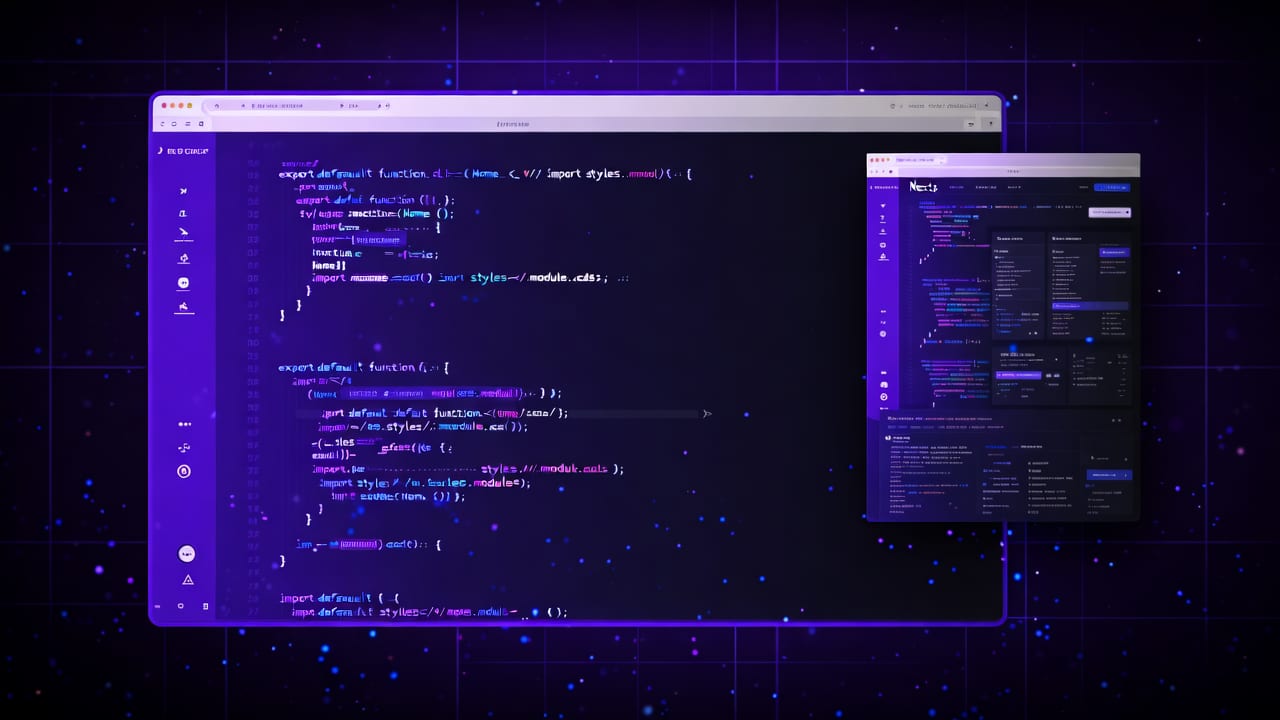
Many tools tout “AI-generated websites” — but few confront the reality that all websites evolve. A pricing page needs a new tier. A blog needs SEO meta tags. A dashboard needs authentication guards. If your AI website generator doesn’t let you open app/dashboard/page.tsx and modify it — you’ve bought a prototype, not a product.
ZyloCode treats code as first-class output — not a side effect. Its editor supports:
- Multi-file navigation (click any
.tsxor.tsfile in the sidebar) - TypeScript IntelliSense powered by
tsc --noEmitbackground checking - Tailwind class autocomplete with responsive and dark-mode variants
- Git-aware diffs before export (so you know exactly what changed from the AI’s initial output)
This is why founders choose ZyloCode over alternatives: they don’t just ship faster — they retain full ownership and velocity. As one agency founder told us in April 2026: “We used to spend 3 days wireframing, 5 days building, and 2 days debugging hydration. Now we ship a Next.js MVP in 90 minutes — and hand off fully editable code to our client on day one.”
That’s not possible with tools that treat code as disposable. For a deeper look at why code export is non-negotiable in 2026, see our dedicated guide: AI Website Builder With Code Export — Build, Edit & Deploy in 2026.
Tailwind Integration: Beyond Utility-First Styling
In 2026, Tailwind isn’t just a CSS framework — it’s part of the component contract. A true best AI website generator for Next.js must understand how Tailwind interacts with React Server Components, suspense boundaries, and dynamic class generation.
ZyloCode goes further than basic class injection. It:
- Generates responsive variants only where needed (e.g.,
sm:text-lg md:text-xlonly for headings with multi-breakpoint requirements) - Respects
@layerdirectives and plugin configurations (like@headlessui/reactor@heroicons/react) - Outputs dark mode classes conditionally — never forcing
dark:unless explicitly requested or logically implied (e.g., “modern tech dashboard with dark theme”) - Includes
tailwind.config.tswith safe defaults, extendable via editor
Compare that to tools that dump raw class="..." strings into JSX — often bloating bundle size and breaking JIT compilation. For a full breakdown of how AI-generated Tailwind sites should work in 2026, read: AI-Generated Tailwind Website: Fully Editable & Exportable in 2026.
Use Cases: Who Benefits Most From the Best AI Website Generator for Next.js?
The value isn’t uniform across roles. Here’s how different users leverage ZyloCode’s Next.js-native AI generation in practice:
Founders Building MVPs
Time is capital. A founder validating a B2B SaaS idea needs a landing page, auth flow, and demo dashboard — all Next.js-optimized for performance and SEO. With ZyloCode, they describe their vision in plain English (“A no-code analytics tool landing page with testimonial carousel, interactive feature grid, and /demo sign-up using Clerk”), generate, tweak copy in app/page.tsx, and deploy. No dev hiring, no template hunting, no Stack Overflow rabbit holes.
Freelancers Serving Multiple Clients
Freelancers juggle scope, deadlines, and consistency. ZyloCode lets them create reusable prompt templates (“Client X: Portfolio site with case studies, contact form, and Framer-like animations”) — then regenerate and adapt for each client. Since every site ships with clean, documented code, onboarding junior devs or handing off to clients is frictionless.
Agencies Scaling Delivery
Agencies use ZyloCode as a scaffolding layer. They generate core architecture (routing, layout, data hooks), then plug in custom CMS integrations, analytics, or payment flows. Because the output is standard Next.js, their engineering team reviews pull requests the same way they would for any internal project — no learning curve, no abstraction tax.
For agencies evaluating workflow fit, our side-by-side comparison with v0.dev clarifies trade-offs across scalability, customization, and team collaboration: ZyloCode vs v0.dev: AI Website Builders Compared (2026).
What to Avoid: Red Flags in AI Website Generators
Not all tools claiming Next.js compatibility deliver it. Watch for these 2026 red flags:
- "Next.js-like" or "Next.js-inspired" language: Legitimate tools say "Next.js 15 App Router" — not vague analogies.
- No visible file tree or editor: If you can’t click into
app/layout.tsx, you can’t own the code. - Export requires enterprise pricing: True code ownership shouldn’t be gated behind $299/mo plans.
- Preview-only mode with no TypeScript support: A red flag for production readiness — Next.js projects in 2026 are overwhelmingly TypeScript-first.
- No mention of React Server Components or streaming: Signals outdated training data or shallow architecture understanding.
If a tool checks two or more of these boxes, it’s likely optimized for marketing — not engineering.
Getting Started With the Best AI Website Generator for Next.js
Getting started takes under 90 seconds:
- Go to zylocode.com and sign up (free Hobby tier includes unlimited generations, full code export, and Vercel deployment).
- Type a prompt — e.g., "A sustainable fashion brand homepage with hero video, product grid, sustainability stats section, and newsletter CTA".
- Review the generated
app/page.tsx, tweak copy or CTAs, adjust Tailwind classes in real time. - Click “Deploy to Vercel” — or “Download Code” to host elsewhere or add to your existing repo.
No credit card. No forced onboarding. No hidden limits. Just Next.js, generated intelligently — and yours to keep.
For teams evaluating broader no-code AI workflows, explore how ZyloCode fits into the realistic path to production-ready websites: No-Code AI Website Builder: Build Production-Ready Next.js Sites in 2026.
Final Thoughts
In 2026, the best AI website generator for Next.js isn’t the flashiest — it’s the most honest. It doesn’t hide complexity behind drag-and-drop illusions. It doesn’t gate real code behind paywalls. It generates what you ask for — and trusts you to take it from there.
ZyloCode meets that standard. It’s built for people who need speed *and* sovereignty: founders shipping before competitors hire developers, freelancers delivering polished, maintainable sites, and agencies scaling without sacrificing quality.
If you’re ready to generate, edit, and deploy real Next.js websites — not demos — start with ZyloCode today.
Apply the playbook
Ready to build your website?
Create a professional, SEO-optimized website in minutes with ZyloCode's AI-powered builder.
Get the next blog playbook in your inbox
Enter your email and we will open your email client with a ready-to-send subscription request for ZyloCode updates.
Previous article
AI Website Builder With Code Export — Build, Edit & Deploy in 2026
Looking for an AI website builder with code export? ZyloCode generates production-ready Next.js + Tailwind sites from text prompts — and lets you export fully editable
Next article
No-Code Next.js Website Builder (2026)
Discover the most capable no-code Next.js website builder in 2026 — one that delivers production-ready, editable code, not just static previews. Learn how ZyloCode
Related articles
Keep reading
These articles connect closely to the strategy, launch, or optimization themes in this post.

No-Code AI Website Builder: Build Production-Ready Next.js Sites in
Discover the best no-code AI website builder for 2026 — ZyloCode generates editable, production-ready Next.js + Tailwind sites from text prompts. No dev skills needed.


