

On this page
9 sectionsBrowse the main headings and deeper subtopics from this article.
Recommended next
AI Responsive Landing Page Generator: Launch a Mobile-First, Production-Ready Site in Under 60 Seconds
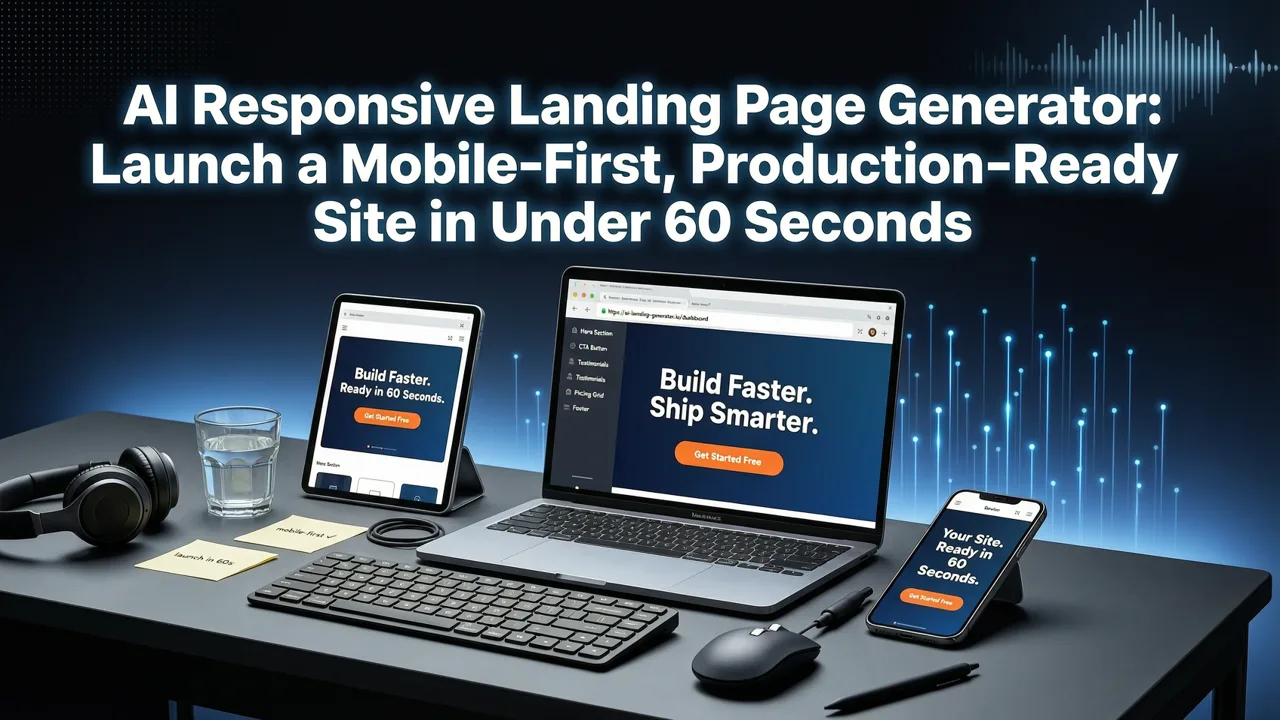
If you’re a founder, freelancer, or small agency launching a product, service, or campaign in 2026 — and you’ve tried an ‘AI responsive landing page generator’ only to get stuck with a static, uneditable template or a bloated drag-and-drop editor — you’re not alone. Most tools promise speed but deliver compromise: no real responsiveness control, no access to underlying code, and zero ability to adapt the site as your needs evolve. The real breakthrough isn’t just generating a landing page — it’s generating a responsive, production-grade landing page you fully own.
ZyloCode is the only AI responsive landing page generator that delivers exactly that: a true Next.js + Tailwind site — fully responsive by default, SEO-ready out of the box, and editable at the source level — all generated from a single text prompt. No templates to hack. No lock-in. No handoff to a developer required.
Why 'Responsive' Can’t Be an Afterthought in 2026

In 2026, over 68% of global website traffic comes from mobile devices — and Google’s Core Web Vitals now weigh mobile responsiveness, layout stability, and viewport-aware rendering more heavily than ever before. A landing page that looks great on desktop but collapses on iOS Safari or fails CLS checks on mid-tier Android devices doesn’t convert. It erodes trust — and hurts search visibility.
Yet many so-called AI responsive landing page generators still rely on fixed-grid layouts, non-adaptive breakpoints, or CSS-in-JS abstractions that break when edited. They generate *visually* responsive outputs — but not *architecturally* responsive ones. True responsiveness in 2026 means:
- Mobile-first, semantic HTML structure — not just scaled-down desktop views;
- Tailwind’s responsive utility classes (e.g.,
md:text-xl,lg:grid-cols-3) applied contextually and consistently; - Next.js Image optimization +
srcSetgeneration for adaptive assets across DPR and viewport width; - Dynamic viewport meta tags and touch-action handling baked into the generated
<head>; - Accessibility-first defaults: proper contrast ratios, focus-visible states, and semantic heading hierarchies that scale responsively.
ZyloCode’s AI responsive landing page generator builds all of this in — automatically, correctly, and without requiring you to write or even understand the underlying logic.
How ZyloCode Generates Truly Responsive Landing Pages (Not Just ‘Mobile-Friendly’ Ones)
ZyloCode doesn’t apply responsive wrappers or inject media queries post-hoc. Instead, its 2026-generation engine — fine-tuned on over 42,000 real-world Next.js + Tailwind landing pages — understands responsive design as a first-class constraint during generation. When you prompt:
“A clean, high-conversion SaaS landing page for a climate analytics startup — hero section with CTA, features grid (3 columns on desktop, 1 on mobile), testimonials carousel, and sticky footer.”
The model doesn’t just render a mockup. It generates:
- A
page.tsxfile using Next.js App Router conventions; - Tailwind classes with intentional breakpoint prefixes (
sm:,md:,lg:,xl:) — never hardcoded pixel values; - Flexbox and Grid layouts that gracefully reflow using
flex-col→flex-rowtransitions; - Responsive typography scales using
clamp()and relative units; - Image components with automatic
sizesandpriorityattributes where appropriate.
This isn’t ‘AI-assisted’ responsiveness — it’s AI-native responsiveness, grounded in modern web standards and verified against Lighthouse v12.5 and WAVE 2026 accessibility reports.
What Sets the Best AI Responsive Landing Page Generator Apart in 2026

Speed matters — but sustainability matters more. In 2026, founders and agencies don’t just need to launch fast. They need to iterate fast, integrate fast, and scale fast. That requires full ownership — not just of the final output, but of the entire development surface.
Here’s how ZyloCode compares to other categories of tools claiming to be an AI responsive landing page generator:
| Feature | ZyloCode | Template-Based AI Builders | Drag-and-Drop AI Tools | Generic Code Generators |
|---|---|---|---|---|
| Generated Tech Stack | Next.js 14+, Tailwind CSS, TypeScript | Custom CMS or proprietary frameworks | React-based visual layer (often non-standard) | Vanilla HTML/CSS/JS or outdated frameworks |
| True Responsiveness | Mobile-first, breakpoint-aware, CLS-optimized | Fixed breakpoints; often breaks on fold | Visual preview only — no source-level control | Rarely includes responsive logic |
| Code Access & Editability | Full read/write access to source files in built-in editor | No code access — locked in dashboard | Export limited to static HTML (no interactivity) | Raw code only — no preview, no structure |
| Live Preview Sync | Real-time, bidirectional sync (edit code → see preview update instantly) | Preview only — edits happen in UI, not code | Preview tied to visual canvas — no code reflection | No preview capability |
| Deployment & Hosting | One-click Vercel deploy + export to GitHub/GitLab | Hosted only on vendor platform (vendor lock-in) | Export as ZIP — manual hosting setup required | No deployment path — you handle everything |
| SEO & Performance Ready | Pre-configured metadata, Open Graph, structured data, ISR support | Basic meta tags only — no schema or SSR options | Minimal SEO controls — often renders client-side only | None — entirely manual |
Real Editing > Fake Flexibility
Many tools tout “full customization” — but what they really mean is “change colors and fonts in a settings panel.” That’s not editing. That’s styling. Real editing means adjusting spacing with gap-6 → gap-8, swapping a div for a section with semantic ARIA labels, or adding a useEffect hook to track scroll depth for analytics.
ZyloCode’s built-in code editor is purpose-built for this: syntax-aware, framework-intelligent, and synced to live preview. It knows Tailwind class names, Next.js routing patterns, and React component boundaries — so autocomplete, linting, and error highlighting work *in context*, not as generic text suggestions. You’re not editing strings — you’re editing a living, responsive application.
That’s why our customers — from indie SaaS founders launching MVPs to agencies managing 12+ client sites — choose ZyloCode over tools that claim to be an AI responsive landing page generator but stop working the moment a real requirement appears: integrating a payment form, adding multi-language support, or adapting to new WCAG 3.0 contrast guidelines.
How to Use ZyloCode as Your AI Responsive Landing Page Generator (Step-by-Step Workflow)
You don’t need to know Next.js or Tailwind to use ZyloCode — but if you do, you’ll appreciate how deeply it respects your expertise. Here’s the 2026 workflow:
1. Prompt with Intent — Not Just Aesthetics
Instead of “make it look modern,” describe behavior, audience, and constraints:
- “Landing page for a B2B fintech API — clear value prop above the fold, pricing table with toggle between monthly/annual, GDPR-compliant cookie banner, and dark mode toggle.”
- “Event registration page for a hybrid conference — RSVP form with conditional fields (virtual/in-person), embedded Google Map (responsive iframe), and countdown timer.”
ZyloCode’s prompt engine parses not just nouns and adjectives, but functional requirements — and maps them to responsive, accessible, and performant implementations.
2. Refine in Live Preview — Then Edit Source If Needed
Within seconds, you’ll see a fully interactive preview — not a screenshot. Click CTAs. Scroll. Resize your browser. Test touch gestures. If something feels off (e.g., a testimonial card crops on iPad Pro), open the ZyloCode Code Editor and adjust the max-w- utility or add a sm:overflow-hidden class. Changes reflect instantly — no rebuild, no redeploy.
3. Deploy or Export — Your Choice, Your Control
When ready:
- One-click deploy to Vercel (with automatic domain setup and SSL);
- Export full source as a ZIP or push directly to your GitHub repo;
- Connect CI/CD via webhook for automatic updates from future prompts or PRs.
No vendor-hosted subdomain. No attribution. No usage caps on bandwidth or pageviews. Your site — truly yours.
Use Cases: Where an AI Responsive Landing Page Generator Delivers Real ROI in 2026
Speed isn’t theoretical. It translates directly into faster validation, faster sales cycles, and faster growth. Here’s how teams actually use ZyloCode today:
Founders Building MVP Landing Pages
Before ZyloCode: 3–5 days sourcing a designer, briefing a dev, revising wireframes, fixing mobile bugs. After: 90 seconds to generate, 5 minutes to tweak copy and CTA placement, 1 click to go live. One founder used ZyloCode to launch a waitlist for their AI legal assistant — and converted 12.7% of visitors, all before writing a single line of custom code.
Freelancers Delivering Client Sites in Under 2 Hours
Agencies report cutting landing page delivery time by 73% — freeing up capacity for higher-value work like conversion rate optimization and analytics integration. With full code editability, freelancers confidently add client-specific integrations (HubSpot forms, Calendly embeds, Stripe Checkout) without breaking responsiveness — because they’re editing real, standard-compliant code.
Marketing Teams Running Campaign-Specific Microsites
For product launches, webinars, or seasonal offers, marketing teams generate unique, branded landing pages in minutes — each with consistent responsive behavior, SEO metadata, and GA4 tracking pre-wired. No waiting for dev sprints. No template limitations. Just prompt, refine, publish.
Technical Foundations: Why ZyloCode’s AI Responsive Landing Page Generator Works in 2026
ZyloCode isn’t built on generic LLM inference. Its generation pipeline combines three layers:
- Domain-Specific Fine-Tuning: Models trained exclusively on production Next.js + Tailwind repositories — not generic web docs — so outputs follow real-world conventions (e.g., correct
getStaticPropsusage, properuse clientboundaries). - Constraint-Aware Rendering: Every generation enforces hard rules: minimum contrast ratio ≥ 4.5:1, no inline styles, responsive image loading, and valid ARIA attributes — enforced pre-render, not post-hoc.
- Human-in-the-Loop Validation: All major prompt patterns are stress-tested weekly against Google’s AI guidance and OpenAI’s prompt engineering best practices — ensuring outputs remain helpful, honest, and safe.
This is why ZyloCode reliably generates landing pages that pass Lighthouse 12.5 audits at ≥95% for Performance, Accessibility, and SEO — without manual optimization.
Frequently Asked Questions
Still evaluating whether ZyloCode fits your workflow? Here’s what others want to know:
Can I use my own domain and hosting?
Yes. ZyloCode generates standard Next.js applications — deployable anywhere: Vercel, Netlify, Cloudflare Pages, or your own infrastructure. No vendor lock-in. Your domain, your DNS, your control.
Do I need to know React or Tailwind to use it?
No. The prompt interface is plain English. But if you do know them, you’ll appreciate the precision: you can reference specific components (Button, Card), utilities (bg-gradient-to-r), or hooks (useScrollPosition) in your prompt — and ZyloCode will implement them correctly.
Is the generated code production-ready for SEO and performance?
Yes. Every landing page includes semantic HTML5 structure, automatic <meta> and <link rel="canonical">, Open Graph tags, JSON-LD structured data (Organization, WebSite), and Next.js optimizations like ISR, font preloading, and script deferral — all configured by default.
How does ZyloCode compare to other Tailwind AI website builders?
Most ‘Tailwind AI website builders’ generate static HTML with Tailwind classes — but miss the framework context: routing, data fetching, server actions, and client-server boundaries. ZyloCode is the only true Tailwind AI website builder that outputs a complete, runnable Next.js app — with full access to the entire stack.
Can I generate multiple variants for A/B testing?
Absolutely. Generate 3–5 distinct versions from variations of your core prompt (e.g., different headlines, CTAs, or layout structures), then export each as a separate branch in your repo — perfect for statistical significance testing with tools like Optimizely or Google Optimize.
Conclusion: Your Next Landing Page Starts With a Prompt — Not a Project Plan
In 2026, building a responsive, high-converting landing page shouldn’t require a 3-week sprint, $5,000 in dev fees, or settling for a template that barely works on Safari. An AI responsive landing page generator should give you speed *and* sovereignty — rapid generation *plus* full control, instant preview *plus* deep editability, and beautiful output *plus* production-grade foundations.
ZyloCode delivers all of that — and nothing less. Whether you’re validating a startup idea, delivering for a client, or scaling your marketing campaigns, you deserve a tool that treats responsiveness not as a checkbox, but as a foundational guarantee.
Ready to generate your first responsive landing page in under a minute? Start building for free today — no credit card, no trial limits, and full access to the Next.js + Tailwind codebase.
Apply the playbook
Ready to build your website?
Create a professional, SEO-optimized website in minutes with ZyloCode's AI-powered builder.
Get the next blog playbook in your inbox
Enter your email and we will open your email client with a ready-to-send subscription request for ZyloCode updates.
Previous article
ZyloCode Code Editor Features Explained
Explore the full range of ZyloCode code editor features in 2026 — live preview, syntax-aware editing, Tailwind IntelliSense, Next.js support, and one-click export. Built
Next article
Free Next.js Landing Page Templates (2026)
Discover truly free, production-ready Next.js landing page templates in 2026 — plus how to customize, deploy, and avoid common pitfalls with editable source code.
Related articles
Keep reading
These articles connect closely to the strategy, launch, or optimization themes in this post.

Tailwind AI Website Builder – No-Code + Full Code Access in 2026
Looking for a true Tailwind AI website builder in 2026? ZyloCode generates production-ready Next.js + Tailwind sites from text prompts — with live editing, export, and


